
 See prices


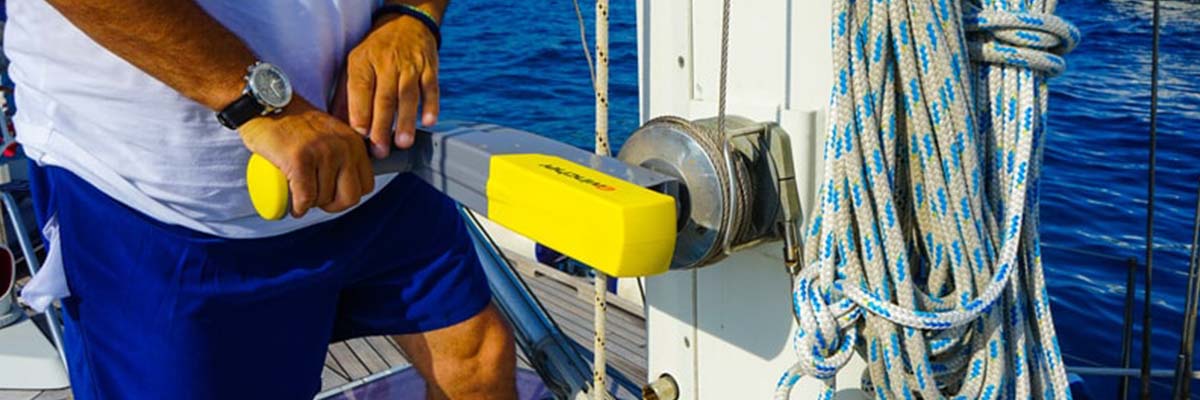
Test, in real conditions, of Ewincher, the electric winch handle by Yachting Media
International Yachting Media tested Ewincher in every detail and they approved it!
Here is their review: made by Luca D'Ambrosio on June 27, 2018 - Source</p >
The challenge was launched during the last boat show in La Grande Motte when Bruno Rabu, the creator of Ewincher, gave us the electric winch handle and invited us to try it on board our boat. In fact, the crank had already caught our attention because it has the same size as a traditional crank, latest generation electronics compatible with a free Application. She certainly couldn't go unnoticed.
In the past, we had tried other cranks but all of them, in one way or another, disappointed us. Too bulky or not very powerful, dependent on a power cable or with low autonomy, they led us to advise against the purchase and to prefer the electrification of a winch already available on board. Then Ewincher arrived and we tried it, both dry and on board, and we really liked it. The latest generation batteries, lightness and Application are all the characteristics that make this product a valuable and truly effective instrument to facilitate all on-board maneuvers. But let's take it step by step and see how the crank behaved during our test.
The Ewincher test, the electric winch handle
Ewincher is designed to stay on board and take up little space, as suggested by its lightweight, compact and easy-to-carry case. By opening the zipper of the bag, you find the crank, two batteries, a 220v charger and a user manual.
Our first test is quite classic: we try to use it without reading the instructions. So I simply take a battery, insert it on the crank and press the power button. The crank activates and works; everything is very easy and intuitive.
The second test is dedicated to the App; I download it from the store and, quite simply, my phone connects to the crank giving me all the information I need. Thanks to the App, I can see the state of charge of the battery, the history of the loads that the crank has moved, the effort in kg that it exerts in real time.
In addition, I can configure the maximum crank load and maximum motor power so that the crank can never exceed these parameters.
Obviously, Ewincher does not need the App to function because it is completely autonomous; However, it is nice to have all this data at your fingertips. The crank is equipped with two buttons: the first, positioned “within reach of the finger” and therefore on the handle, allows the device to activate while the second, located under the handle and therefore far from any kind of accidental actuation , allows you to change the direction of rotation of the crank.
Ewincher, in fact, provides four operating modes: Fast mode: using the high speed of the winch, you can carry out the most difficult and strenuous maneuvers extremely quickly. Slow and powerful mode: using the winch speed, the crank lifts double the weight but without any effort. Combined mode: by adding your speed to that of the crank, you can benefit from exceptional speed and steering power. The system is very fast and very efficient. Manual mode: Ewincher can also operate as a traditional crank for maximum precision.
After discharging the battery, we charged it using the 220v charger, converter and 12v available on board. We recorded a charging time of one hour and 27 minutes in the first case, one hour and 31 minutes in the second case. In both cases, the charging time was less than that declared by the manufacturer, which is equal to one and a half hours. Now that the battery is charged we can use it.
Edge test
The Ewincher “comfort zone” declared by the manufacturer is between 30 and 50 feet, both for mono- and multi-hulls. In addition, according to the instructions provided by the producer, the height of the mainsail should not exceed 18 meters.
Given the versatility of the product, we decided to carry out our tests on board boats of different sizes in order to evaluate its performance with different workloads.
So we tried the crank either on board our laboratory boat, our 46-foot-long Daydreamer, or on a smaller 40-foot-long boat. On our laboratory boat, Ewincher was used for two weeks (it replaced the hydraulic winches our boat is equipped with) without ever showing signs of failure.
During our excursions, we only needed to replace the standard battery with the backup one – although the genoa of our Daydreamer has a surface area of 82 square meters – because the charge of the first battery was always more than sufficient.
On this boat we used Ewincher for different purposes. The crank assisted us during the maneuvers of opening the genoa (the mainsail is furling), adjusting the genoa and the mainsheet and even during our anchoring maneuvers which became very simple.
On the 40-foot-long boat, on the other hand, we carried out a test during a windy day, sailing from morning to evening.
On this occasion, we sailed aboard a Dufour 40 which, equipped with an oversized mast and a traditional mainsail, was a more difficult and responsive boat to maneuver. During this day we hoisted the mainsail twice, opened and closed the genoa 4 times, hoisted the gennaker once and used Ewincher to trim the sails. This time, at the start of the evening, the battery state of charge was 15%; therefore, we replaced it with the emergency one which, during mooring maneuvers, showed a charge level equal to 55%.
During our tests, we also tested the waterproofness of the device; we have, in fact, “watered” Ewincher three times without ever compromising the qualities of Ewincher, where the IPX6 standard is well assured. Finally, we used the crank beyond the limits recommended by the manufacturer. We installed it aboard a Gulliver 57, equipped with a 23 meter mast and an oversized mainsail.
Given the dimensions of the sail, this boat is characterized by a halyard of 46 meters which therefore goes well beyond the limits recommended for this electric crank. Ewincher raised the mainsail without problems up to three quarters – around 30 meters – then it stopped, protected against overheating by a thermal safety device.
After 5 minutes, it cooled down and completed the maneuver. A real success! It's true, we shouldn't do that, but, after all, our job is to test products and go beyond the limits. In any case, Ewincher worked well, she communicated to us that we were exaggerating and, finally, she finished her work.
Conclusions Why buy an Ewincher crank?
This accessory is reliable, versatile and can be used for all purposes. Perfect for those who sail solo or with a small crew, it allows you to carry out all the maneuvers quickly and easily. Ewincher allows you to carry out all the maneuvers: hoisting, trimming, adjusting the sails, furling your genoa or even mounting a crew member on the mast.
In addition, if we consider that 2,299 euros are enough to automate the entire boat – a sum considerably lower than the electrification of a single winch – we can realize that this crank could represent a good choice . The crank is the same size as a traditional crank and is supplied with a crank lock. Finally, it is the only handle currently available on the market to have a locking mechanism which allows it to be left installed on the winch when not in use. Despite our efforts, we were unable to find any faults.
It’s a really good product.
Electric winch handle Adjustable rotation speed: from 0 to 100 RPM Torque and Power: 90 NM- 450 W Weight: 2.2 Kg
Battery: 24 V, lithium, with a capacity of 3000 mAh
Battery charging time: one and a half hours