
 See prices


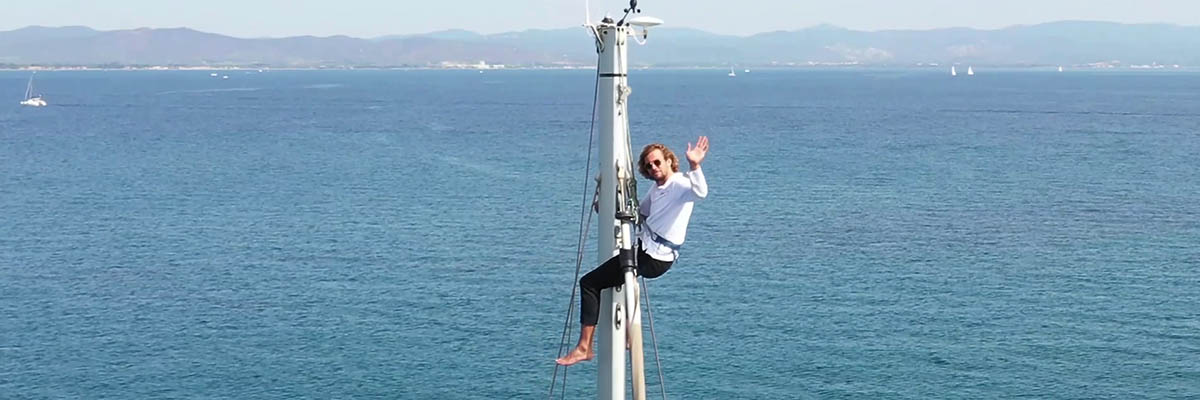
The climb to the mast, an impressive, perilous and crucial maneuver!
Every sailor has already been confronted with this famous moment...
Climbing the mast. Regular monitoring of equipment at the masthead is necessary. Checking the electrical connections, the tightening of various bolts, turnbuckles, etc. will allow you to reduce the risks of climbing the mast in the open sea. It is worth remembering that climbing the mast is not without risks and that precautions must be taken (before and during the maneuver). Finding yourself several meters high can be very impressive. This is why, do not hesitate to call on riggers to carry out this work if you do not feel capable of doing so (lack of technique, physical health, equipment, etc.).
You will surely find, in our reseller area, seasoned professionals who will be able to assist and advise you. Climb the mast at the dock, climb the mast while sailing
Climbing the mast in an emergency has nothing to do with climbing the mast moored in port. This is a much riskier but essential maneuver. If a halyard is stuck, if an instrument necessary for navigation is faulty (such as the anemometer vane or the VHF antenna, etc.) or if rivets need to be redone, climbing the mast is necessary. Solving the problem will be essential for a safe return to port. This is very different from climbing the mast at the dock to carry out a check or preventive maintenance. The sailboat is then immobile, or almost. But for all that, there is no question of not being careful. Properly equipping yourself remains essential. Wearing gloves, pants, a helmet and shoes is far from superfluous. Also don’t forget to set up redundant security.
Climbing the mast: safety above all
Even moored, a roll is capable of throwing you several meters. This effect is multiplied in the open sea. In fact, the movements of the swell are greatly amplified at the masthead. Pay attention to the return shock. Seasickness is common at the top of the mast, even for the most experienced sailors. To minimize this swing, you can choose to place yourself inside a strap that you will slide around the mast of the sailboat.
This will prevent you from straying too far…
It is also essential to prepare your tools well. Once at the masthead, it is a shame to realize that you have forgotten a screwdriver, for example, without having planned a solution to be able to raise it without having to come back down. In addition, the fall of a tool can cause a serious accident for the crew below. Don't forget that your boat will not emerge unscathed from the impact of a tool dropped several meters (plexiglass, etc.).
Arms, to climb the masts?
All this is without taking into account the problem of the strength, the power necessary to hoist oneself or be hoisted to the masthead. With a little luck, you have a crew with a strong member who is willing to “warm” their arms by turning the winch. In addition to a significant and, if possible, regular effort, your teammate will need to keep an eye on the person they are hoisting in order to avoid any incidents during the climb to the top of the mast. It is also possible to use the spinnaker halyard. This has the advantage of being located closer to the windlass. If you are lucky, the windlass is electric and equipped with a winch headstock. Thus, with a return pulley towards the latter, you will be able to lift the climber, not with the strength of your arms but with the help of the boat's batteries.
Otherwise, there is Ewincher, the electric winch handle!
For happy sailors in possession of an Ewincher, climbing the mast is made easier and safer! The crew member responsible for operating the winch does not have to be in great physical shape to be able to help you climb the mast. What's more, the force exerted on the halyard to hoist you up will be regular and will therefore avoid jerks. This is all the more important with the phenomenon of amplification of swell movements.
Ewincher is a real team member on the boat. The “wincher” can be particularly attentive during the climb and concentrate on it rather than being focused on his physical effort.
Your teammate does not risk injury. Indeed, in order to avoid damage to the equipment, and for your own safety, Ewincher is equipped with a torque limiter, directly accessible on all smartphones via the Ewincher application, downloadable for free on Android or IOS. Finally, even if the voltage also acts on Ewincher, the electric winch handle can be used on both winch speeds. You just have to reverse the direction of rotation to use, still in electric mode, the low speed of the winch. Don’t hesitate to watch our video.
You can see a team member climbing the mast using Ewincher. The test was carried out on the “Florenzo” a Sun Odyssey 509. If you have a question, we or one of our reseller partners will be happy to answer you.